Showing posts with label Lent. Show all posts

Tuesday, February 13, 2024

B, Ash Wednesday - Genesis 3:14-19 "You are Dust, and to Dust you shall Return"

Genesis 3:14–19 (ESV) “The LORD God said to the serpent, ‘Because you have done this, cursed are you above all livestock and above all beasts of the field; on your belly you shall go, and dust you shall eat all the days of your life.  I will put enmity between you and the woman, and between your offspring and her offspring; he shall bruise your head, and you shall bruise his heel.’  To the woman he said, ‘I will surely multiply your pain in childbearing; in pain you shall bring forth children. Your desire shall be contrary to your husband, but he shall rule over you.’  And to Adam he said, ‘Because you have listened to the voice of your wife and have eaten of the tree of which I commanded you, ‘You shall not eat of it,’ cursed is the ground because of you; in pain you shall eat of it all the days of your life;  thorns and thistles it shall bring forth for you; and you shall eat the plants of the field.  By the sweat of your face you shall eat bread, till you return to the ground, for out of it you were taken; for you are dust, and to dust you shall return.’”

Air, water, and fire, return all things back to natural elements.  From the moment we create things on this earth, they are returning to what they once were.  The houses people have built since time began have returned, and are returning, to the earth, through exposure to air, water, or fire. 

The goods we place in our homes will also return to primary elements.  Some quickly, some slowly, but nevertheless they are returning.  Even plastics, glass, and porcelain return having been produced with fire, return with the help of fire and pressure over time!

All metals eventually revert to their mineral compounds through the process of corrosion and rust, so that they become dust once again.  Having this in mind we travel in vehicles not putting too much trust in our means of transport.  A very sobering thought to contemplate when we’re at thirty-eight thousand feet, looking at a metal wing, slowly returning to the ore of the earth, keeping us aloft.   Or, sailing on a metal ship, in a salty brine knowing that eventually rust, must make metal, into mush!

It’s not just things we create, that are reduced to rust, dust, a mushy mash, or blackened ash.  All things given to us in this creation will die and return to he who created it with his Word.  

Following a garden and kitchen waste recycling truck yesterday, it became obvious to the nose that air and water were working on returning things, we live on in creation, back into compost and dirt.  Another sobering thought occurred to me, as I drove behind that truck, that I too, in the fullness of God’s time, will be returned from flesh, blood, and bone, back into air, water, and dust.

In a short time, you will receive the mark of the cross on the forehead with ash and hear the words, “you are dust and to dust you shall return. 

These words are the words of God to Adam, who having listened to Eve and Satan disguised as a serpent, did not heed God’s call not to eat from the tree of knowledge of good and evil. 

As a result, not only does Adam return to dust; Eve does too!   All animals that carry the breath of life from God, return to the earth.  All of creation groans as a result of humanity’s pleasure.  And so, all the things in which we seek pleasure, are being tested by air, water, and fire.

The ash we receive on the forehead reminds us of this!  The ash used is the ash of palm fronds.  Traditionally the palm branches used on Palm Sunday, are returned to ash with air and fire, to use on Ash Wednesday.  The Ash adheres to the moisture on the skin of the forehead.  Moisture that is continually leaving the body, which one day will work with air to make us compostable material in the earth.  If not, some will return to ash and dust through cremation’s fire.  Either way, “you are dust and to dust you shall return.

Palm Sunday begins Holy Week.  The ash of the Sunday palm branch not only leads us to remember our mortality, but that of the man Jesus Christ.  He is the New Adam!  The immortal Son of God born into his own creation as a mortal, the Son of Man. 

From Ash Wednesday we look forward to Holy Week, to see what Jesus put aside as the Son of God, and what he endured as the Son of Man.  We see our pleasures, in the face of Adam and Eve’s pleasure, in gaining a knowledge of good and evil.  And we realise the suffering we endure as a result of treasuring the pleasures of what we seek and know, more than the pleasure of knowing God and being known by God.

But we also look to Holy Week and see Jesus’ good pleasure in being led to the cross amid the pain and suffering promised to Adam and Eve from their original sin, and all the sins that followed.  Right the way to today to the deceptions of your pleasures within, and all those around you tempting you because you are without!

We look to Jesus’ death, burial, and descent into hell.  Where, having been pierced by the sword on the cross, water and blood flowed from his flesh!  Where, in the grave, air did not take effect on Jesus’ flesh.   And, where in hell, fire was not fatal for the Son of Man, the Son of God.

We look to Easter Sunday, to the resurrection of Jesus from the grave, trusting that it is the Father’s, the Son’s, and the Holy Spirit’s good pleasure, to work their holiness for you in the events of Holy Week, and Easter.

We also look forward from Ash Wednesday to the day of our death, to our burial or cremation.  Hearing the fulfilment of God’s word, “you are dust, and to dust you shall return”!   And we remember our sin!  The sins we have done, and the sins from which we struggle to be undone.  We see our being, in need of renewal and resurrection, our mortality in need of immortality!

God calls us to look beneath the temporary decaying clothing God gave Adam and Eve to cover their sinfulness, saying, “‘Yet even now,’ declares the LORD, ‘return to me with all your heart, with fasting, with weeping, and with mourning;  and rend your hearts and not your garments.’ Return to the LORD your God, for he is gracious and merciful, slow to anger, and abounding in steadfast love; and he relents over disaster.”  (Joel 2:12–13 ESV)

During Lent some find it healthy to forgo some of the pleasures of this life to focus on the pleasures of God and what was done to save us from the decay caused by our pleasures.  This is a rendering of one’s heart, through fasting, hearing God’s word, and meditating on it. 

Going without in the forty days of Lent, leads one to be tested, and having been tested, produces repentance, as one quickly sees in our failures, Jesus’ being tested for forty days without sin.

Ash Wednesday calls us to see Jesus raised from the dead, victorious over sin, death, and the devil.  In Jesus we see flesh without failure, without fatigue, and our flesh in the future.  We see our mortality made immortal through Jesus’ pleasure to fulfil our Father’s will!

On Ash Wednesday we see the only way is Jesus’ way.  In him the Holy Spirit opens our eyes to pleasure’s temptation of good and evil.   This leads us to turn back to God our Father in repentance and thanksgiving. 

Ash Wednesday helps us to remember and return to the Lord our God, for he is gracious and merciful, slow to anger, and abounding in steadfast love.

In Jesus’ suffering, death, and resurrection, our Father in heaven promises to relent and repent over all your evils!  Amen.

Friday, February 24, 2023

A, Lent 1- Romans 5:19 "Hypo-Hearing"

Romans 5: 19 (ESV) For as by the one man’s disobedience the many were made sinners, so by the one man’s obedience the many will be made righteous.

The foundational disobedience event for humanity is the Old Testament reading for today. 

In Genesis two and three, humanity lost its innocence when Adam and Eve chose to disobey God’s command.  One negative command in the Garden of Eden.  One “no” in a pleasant place of seemingly infinite “yeses”.  Eden literally means “soft, delight, or pleasure.  It was God’s Garden of Pleasure for Adam and Eve!

Living this side of the fall, our eyes are immediately opened, hearing of Eden being a garden of delight and pleasure.  We live with increasing hardship in these days, we seek to recreate, but fail in finding the pleasure to which humanity lost access when they chose to break the one prohibition in creation of innocence and blessing.

In Romans five Saint Paul reflects, “For as by the one man’s disobedience the many were made sinners, so by the one man’s obedience the many will be made righteous.”  (Romans 5: 19 ESV)

We stand at the start of Lent reflecting on this event today.  And as we do there is temptation to think, “if only Adam and Eve didn’t make that one simple mistake”. But although we have no way of knowing how history would have unfolded if they didn’t, after the fall they, and we, continue to fall and add to the first act of disobedience at the start of time.

Adam and Eve did not make one mistake and then lived without any more sin.  Immediately after the fall and being thrown out of the garden, Adam and Eve continue in their disobedience.

But before we hear about this, we need to understand what this disobedience is, so we can understand ourselves, and the obedience of Jesus which saves us and makes us holy.  Then the Holy Spirit can continue bringing us to, and infilling us with, the holiness of God.

Because we live this side of the fall, our natural tendency is to think obedience is about “doing” the right thing.  Although this is somewhat true, it is only partially true.  Because we are turned in on ourselves, we think, “if I do the right thing, then I am a righteous person”.  But the problem with our doing is in the “I think – I do” logic.

If obedience is about, “ I think, I do”, then most of humanity is obedient.  But what happens when what I think and do is different to what you think and do?  One’s thinking and doing will end up harming someone else’s thinking and doing.

Any parent that’s frustrated with their children, practises obedience teaching every time they lose it with their children. 

If and when one raises their voice at our children we do not usually say, “you are not being obedient, or stop being disobedient”.  Nor does one usually say, “stop doing what you’re doing”. 

No!  One who is frustrated with their children will raise their voice and say, “stop, you’re not listening.  Listen to me!”

Obedience is primarily about listening, and once hearing is heard, then the secondary act of doing can occur! 

This is because obedience occurs in community.  The parent is frustrated with their child or children in the nucleus of a family.  This is God’s original community.  In fact, all community is an extension of the household community of parents and children.  All authority flows from God to humanity through the family unit.  But since the fall, disobedience and loss of innocence also comes to us, not from God, but from Adam and Eve!

Notice it’s Adam who is named as being the one through whom sin came into the world.  Eve took the fruit, but it’s Adam who bore the responsibility for the sin.  Adam did not listen to God and broke the authority invested in him by God.  And in not listening he turned his back on God towards Eve and the serpent, to listen to their distortion of God’s Word, then participated in the act of eating themselves into death.  Community broke down between Adam and God when he listened and acted with Eve.  As a result, his relationship with Eve was also corrupted.

At this point I delight in telling you one of my favourite quotes from Luther’s Table Talk.  Martin Luther, being a very earthy Middle Ages man, said, “Almost every night when I wake up the devil is there and wants to dispute with me… I instantly chase him away with a fart.” (Luther’s Works 54:78)

Crass, yes!  But it is excellent classic practical theology!  For when you’re breaking wind in the devil’s face one is reversing the authority order of the fall at Eden.  If only Eve had turned her back on the devil, it would have been the holiest and most blessed and pleasant fart known to humanity. 

To turn in the devil’s hearing and blow flatulence in his face would have been a turning to her husband, and he with her, a return to the Lord.  They would have remained in the authority of God’s command, not eating of the tree of knowledge of good and evil.  Instead, they could have partaken in the many delights of the garden, including the tree of life, and pleased God in doing so.

But they didn’t and as the cliché goes, “the rest is history”, until at the right time in history, God sent Jesus to do what Adam could not do.

Here too the doing is not the primary action but rather it is the listening.  “For as by the one man’s disobedience the many were made sinners, so by the one man’s obedience the many will be made righteous.”  (Romans 5: 19 ESV)

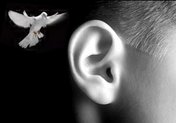
Disobedience and obedience are not just about hearing or listening, then doing.  Rather Saint Paul and the other Epistle writers speak of literally “hypo-hearing” or “under-hearing” when listening to God.  This is listening in submission to God’s Word, and for us it is the listening of the body, or the church, to the head of the church, which is Jesus Christ.

Disobedience here in Paul’s Epistles is “para-hearing”, “contrary-hearing”, or “proximity-hearing”.  One might not listen properly, only hearing in part, or mishearing.  Or a person might read into what they hear, and act on that, like a Chinese whisper gone wrong.

This is what happened at Eden when God told Adam not to eat of the tree.  Somehow, Eve tells the devil a slightly different command from what God had said to Adam.

Adam was commanded, “You may surely eat of every tree of the garden,  but of the tree of the knowledge of good and evil you shall not eat, for in the day that you eat of it you shall surely die.” (Genesis 2:16–17 ESV)

To this Eve added, when quizzed by the devil, “but God said, ‘You shall not eat of the fruit of the tree that is in the midst of the garden, neither shall you touch it, lest you die.’” (Genesis 3:3 ESV)

When touching it, they did not die.  So, they ate, they knew death, and knew they were disobedient.  Instead of “under-hearing” they “contrary-listened” and became “hyper-hearers” they stood over God’s word, placing the authority of God’s Word below their understanding, their touching, and their tasting.

And what followed was the eternal “oops” once the sweet fruit of knowledge soured in the reality of whom it was that they had not listened.

But they continued in this “oops” by believing their immediate offspring would be the one to crush the serpent underfoot, promoting Cain as a champion man.  Wrongly they believed, and therefore named their second born, Abel, which means “second-rate, vain, or unsatisfactory”. 

We know Cain’s sacrifice to God was second rate, where Abel’s offering received God’s favour, leading to Cain murdering Abel, and being cursed by God.  This occurred as a result of Adam and Eve’s expectation and hyper-hearing of God’s promise.  Seth, however, is the one named as son, from which Jesus Christ is later born.  Incidentally, Abel was the first fallen human to enter the Kingdom of God, and second only to Jesus Christ!

Into our fallen world Jesus was born.  He is the true “Hypo-Hearer” of God.  He does not listen contrary to the Word of God, nor does he place himself over God’s Word, even though he is “the Word made Flesh”.

Jesus Christ was sent from the perfect community of the three-person common-unity, “threefold community or Trinity”, of God the Father, God the Son, and God the Holy Spirit.

At the start of his ministry, Jesus was baptised, and the Holy Spirit came down upon him.  Have you ever wondered, “why”?  Why does God the Son need God the Holy Spirit to come down on him in his earthly ministry?

There are two primary reasons.  First, God is a community of life and love, God works in community, everything he created is for community. 

Second, for Jesus to be the perfect servant, the true “hypo-hearer”, “under-hearer”, or “Obedient One”, he had to become as we are, as Adam and Eve were.  With the same nature as us.  But one hundred percent without sin. 

Jesus had to come in complete submission, not resting on a hyper-hearing or para-hearing, but weak, and led by the Holy Spirit, showing himself to be like you and me in every way, sin excepted.

Because of the Holy Spirit’s work of leading him to the cross, and his atonement for us on the cross, we now walk in the holy priesthood of all believers, baptised into Jesus’ “hypo-hearing”, or submission. 

And in receiving Jesus and his Word, we also receive the Holy Spirit, to will us, to inspire us, and lead us from the temptation of disobedience to the holiness, righteousness, and pleasures of God our Father in Jesus Christ.  Amen.

Saturday, February 28, 2015

B, Lent 2 Mark 8:31-38 "Letting Christ Be Your Christ"


During these forty days of Lent we reflect on Jesus’ walk to the cross.  This cross is the cross of shame, the cross of humiliation, a cross of disgrace, remorse and alienation.  Jesus walk to the cross and death was a walk of loneliness, being alone, being set apart from the pack and picked on for being different… and for being the same.

Last week, the first Sunday in Lent, Jesus was baptised and set apart as God’s beloved Son.  With him God was well pleased.  But Jesus immediately finds himself out in the wilderness, literally a lonely place.  Here Jesus felt the full impact of being alone as a human being... the same as you and me!  He was lonely, he was in need, and just like you and me, just like Adam and Eve, he was tempted by the devil to look after his own interests and status. 

The course Jesus chose here is good news for us who struggle being alone with ourselves, desperately wanting to alleviate the loneliness of longing, pain, and suffering by being relevant, by being wanted, and by being popular or well liked.  Rather than the fear of being left out not knowing good and evil, as did Adam and Eve, Jesus did not succumb to his isolation and loneliness but remembered the promise of his Father, “You are my beloved Son; with you I am well pleased.” (Mark 1:11 ESV)

Where you or I fail miserably forgetting God’s promises, where Adam and Eve thought they were left all alone, where we as humanity don’t seem to be able to look past our immediate fickle reality, Jesus saw the bigger picture and turned his face from fame, fortune, and favour and rejected the tempters lure to save himself. Therefore Satan couldn’t accuse him of doubting his Father or not fulfilling his mission to be our Messiah. 

Out in the wilderness Satan’s ultimate goal was to isolate Jesus from the Father cutting him off from God — alone, ashamed, lonely and without hope.  Just like us when Satan uses the shame of our sin against us, and as he did to Adam and Eve in the Garden of Eden.

Now this morning we here Peter rebuking Jesus, in the wake of Peter’s confession that Jesus is “the Messiah”, the Christ, the anointed one!  Jesus announces that his messianic mission, his Christly commission, his anointed assignment was a lonely walk to the cross – into death.  And not just death, Jesus’ rejection by the elders, the chief priests, and the scribes, was a separation from the mainstays of society — not being wanted, or relevant, or well liked.  But like Jesus’ rejection of Satan in the wilderness, his lonely walk is good news for you and me, just as it was for Peter.

But Peter didn’t see it this way.  Like you and me, Peter feared being found to be irrelevant, unpopular, or unliked.   You see he thought Jesus’ messianic mission meant something very different to what Jesus was announcing.  If Jesus wasn’t going to assume his kingdom with glory and prestige and popularity, it meant Peter was going to be left all alone to address the shame of Jesus’ death at the hands of the elders, the chief priests, and the scribes.  He would be ashamed in amongst his community, a Jewish outcast, and he would be remembered and written about as a follower of failure.

No wonder Peter took Jesus aside. We would do the same.  In fact you and I do the same when the loneliness and the horror of our helpless humanity is forced upon us when we are required to stop see our reality.  “No Jesus, surely you’re not going to be anointed like this!” Peter begins accusing Jesus of taking up the messianic mission the wrong way! 

Here again we find Satan back on scene.  In the wilderness Jesus rejects Satan’s offer of relevance, popularity, and prestige, and now Jesus having begun to reveal actually what was to happen Satan seeks to cut Jesus off again.  Every time we take God’s will off the table and replace it with our own relevance, popularity, and prestige we fail as did Peter here,  and again when fear  saw Peter deny Jesus before the rooster crowed, as also did Adam and Eve in the Garden of Eden.  But not Jesus and that’s very good news for humanity.

Only Jesus bore the weakness of humanity without succumbing to the weakness which failed Adam and Eve, Peter, you and I.  Just like Peter, we willing confess Jesus to be the Christ, but when we’re shown that Christ goes and leads the way of the cross the fears and loneliness of the old self sees us duck for cover and hid once again in the shame of our original sinful being and the sin that happens as a result of us being sinful.

  So Peter confesses Jesus as the Christ, and then rebukes Jesus for not being the type of Christ Peter would have him be to hide his weakness, shame, and ordinariness. What Peter is saying to Jesus in his rebuke is this:  If you are going to teach me that you must suffer, be rejected, be killed and then be raised then you are not the Christ, but you are an anti-Christ.

This is why Peter received such sharp words from Jesus when he says, “Get behind me, Satan! For you are not setting your mind on the things of God, but on the things of man.”  (Mark 8:33 ESV)  Jesus heard clearly the accusation from Satan himself, and he rejects Satan again.  The name Satan means to accuse and Peter’s accusation and rebuke of what the Messiah was actually anointed to do shows humainty’s hearts and minds to be set on the things of men rather than on the will of God.

After Jesus reveals the heart of Peter, whose heart is the same as all of us, he takes the opportunity to teach.  And it is in these words of Jesus which I invite you to meditate upon in these days of Lent, to the glory of he who walked the lonely path for me and you!

Jesus said to them, “If anyone would come after me, let him deny himself and take up his cross and follow me.  For whoever would save his life will lose it, but whoever loses his life for my sake and the gospel’s will save it.  For what does it profit a man to gain the whole world and forfeit his soul?  For what can a man give in return for his soul?  For whoever is ashamed of me and of my words in this adulterous and sinful generation, of him will the Son of Man also be ashamed when he comes in the glory of his Father with the holy angels.” (Mark 8:34–38 ESV)

If you choose to deny yourself and follow Jesus, of what can you be accused?  Can Satan make you ashamed of Jesus and his lonely way of the cross?  Can he accuse you of your sin if you take it to the cross, can he really make you alone even when you feel lonely after Jesus has already taken the shame of your sin on himself on the cross?  And further more won the battle over sin death and the devil in his resurrection from the dead!

In our loneliness we seek to build our own little kingdoms, but they are fragile houses of straw which Satan can huff and puff away in an instant leaving us exposed and ashamed of who we are and what we try to be without Christ.

The good news in all of this is when we’re shown for who we really are, naked, ashamed, humiliated, broken, weak, ordinary, and unpopular with ourselves, Jesus has already become all these things for us on the cross in our baptism.  He chose you and took your cross and made it his cross. So it’s time to, stand fast, remain in him and choose to throw off the things that only make us lonely in this world and can give Satan access to make us ashamed of Jesus and his word. 

The good news is now that Jesus has won the victory in the cross we can stick our backsides in the face of the accuser and say, “Get behind me, Satan! For you are not setting your mind on the things of God, but on the things of man.” And pray, “I believe Lord Jesus Christ, save me from my unbelief, Amen.”

Friday, March 23, 2012

B, Lent 5 – John 12:20-33, Hebrews 5:8-10 “To Come and See Jesus”


The place was abuzz. People were expectedly excited as the numbers of visitors made the city's population swell. Jews from all corners of the world had flooded Jerusalem for the Passover, and even more so as the Passover fell on the Sabbath, making the Jewish day of rest, even more special.
But even with this high Sabbath approaching the excitement was not on what was to come, but on he who was already there, and what had just happened.
Jesus seemed to be the man of the moment, everyone scrambling to see this man who had just raised Lazarus from the dead at Bethany. And Lazarus has not just died, but was four days dead! He would have been a decomposing dead man when Jesus opened his tomb and brought him out to his sisters, Mary and Martha.
The temple town was in turmoil. All the attention should have been on the preparation for the Passover. The animals amassed for the sacrifices, the lambs ready for the Passover meal. And yet those who upheld the Jewish Law throw their hands up in disgust that the world has gone after Jesus and showered him with celebration amidst palm branches, just as they once did for King David. (John 12:19)
But unlike the Pharisees and the Jewish leaders, the rest wanted a piece of Jesus. Not only did Jews from all corners of the earth greet Jesus riding on a donkey, but some Greeks wanted to get amongst the excitement and requested an audience with Jesus too.
One can only imagine how the events which had just unfolded would have puzzled the Greeks. After all the Jewish public had signs from Jesus and now the Greeks sought to make sense of Jesus' sign by looking for what wisdom might come out of raising Lazarus, and Jesus receiving a hero's welcome amidst the palm fronds.
We hear the Gospel as it's recorded in John 12:20…
Now among those who went up to worship at the feast were some Greeks. So these came to Philip, who was from Bethsaida in Galilee, and asked him, "Sir, we wish to see Jesus." Philip went and told Andrew; Andrew and Philip went and told Jesus. And Jesus answered them, "The hour has come for the Son of Man to be glorified.
Truly, truly, I say to you, unless a grain of wheat falls into the earth and dies, it remains alone; but if it dies, it bears much fruit.
Whoever loves his life loses it, and whoever hates his life in this world will keep it for eternal life. If anyone serves me, he must follow me; and where I am, there will my servant be also. If anyone serves me, the Father will honour him.
"Now is my soul troubled. And what shall I say? 'Father, save me from this hour'? But for this purpose I have come to this hour. Father, glorify your name." Then a voice came from heaven: "I have glorified it, and I will glorify it again."
The crowd that stood there and heard it said that it had thundered. Others said, "An angel has spoken to him." Jesus answered, "This voice has come for your sake, not mine. Now is the judgment of this world; now will the ruler of this world be cast out. And I, when I am lifted up from the earth, will draw all people to myself." He said this to show by what kind of death he was going to die. (John 12:20–33 ESV)
Now we can't be sure if the Greeks eventually had their audience with Jesus. But from what Jesus said after they made their request through Philip, and the lack of any account of a conversation between Jesus and these Greeks, we must suspect not!
If you think Jesus not speaking with these Greek men puzzling, put yourself in the shoes of the Greeks. They would have been completely confounded by Jesus saying he must be lifted up from the earth to draw all to himself. It might have seemed possible if it wasn't for the fact that, days earlier Jesus had reinstated the life of Lazarus. You see Greeks believed death was the perfect escape from the imperfections of the flesh. Why then would this Jewish hero give life back to Lazarus if he had just escaped his imperfect decaying body?
Nevertheless, they wanted to see Jesus, but Jesus says he is going to be seen by everybody because, "the hour has come for the son of man to be glorified." And, "when I am lifted up from this earth I will draw all people to myself." Jesus glorified God's name in his life, and now he was going to glorify it again in his death and resurrection.
Jesus glorified God's name in his life, he was perfect in God's eyes, and in ours he should be too. Yet God sent him to suffer so in his perfection we might see him be made perfect despite being already perfect and complete. We hear from Hebrews Chapter five…
Although he was a son, he learned obedience through what he suffered. And being made perfect, he became the source of eternal salvation to all who obey him, being designated by God a high priest after the order of Melchizedek. (Hebrews 5:8–10 ESV)
It seemed the whole world had gone after Jesus when he rode into Jerusalem on a donkey after raising Lazarus from the dead. The hopes of Jerusalem had been raised that they would have a king like David on the throne once again! But little did anyone know this man who had captured the hearts and minds of both Jews and Greeks would be designated by God to be the highest of high priests. A perfect priest and a complete king!
Yet it didn't happen in the way we would think! Jesus' completion and coronation as king didn't follow the usual route to power, and once there the judgement bestowed was greater than the judgement of any earthly king, overpowering even the devil, the ruler of this world. Jesus was not only a king but a priest in the order of Melchizedek, who was the king of Salem. A town that was to become Jeru-Salem!
Melchizedek was a priest in Abraham's time. By his name we know he was the king of Salem too. For his name means king, from where we get the name Malachi, and the second part of his name "zedek" means righteousness. He was the high priest and king of Salem, which means peace, from which is derived the Jewish greeting "shalom". And so in Abraham's day much peace flowed to him from Melchizedek the priest and king of righteousness.
But in these days of Jesus, Jerusalem was not peaceable in the least. The crowd was at fever pitch, the priests were worried, and the excitement of the special Passover seemed it might be passed over in favour of Jesus raising Lazarus. Who would have known Jesus' death was the crowning glory of his coronation as king! This was far from being a perfect sign for the Jews and was complete folly to the Greeks.
Yet this was God's plan to have our King of Righteousness enthroned in glory so the entire world might be drawn to him. And so God draws you to him!
His invitation stands everyday for every person to come and receive the Jeru-Shalom – the flow of peace from our High Priest and King in the order of Melchizedek.
You see we are the Greeks in this narrative. Just like them we are Gentile believers looking to the righteousness of Christ on the cross, receiving the flow of peace from the true source of eternal wisdom. And this happens despite all other excitements, disappointments — every good and bad event!
It may have seemed the Greeks lost out in not seeing Jesus that day. But in Jesus' death and resurrection he has been glorified eternally so that all who hear his word are met by him in all his glory as we are daily raised to life by the Holy Spirit having been drowned in our baptism.
This too is an unlikely way, one might think, of being conjoined to Christ's coronation on the cross and victorious resurrection. But, nevertheless, baptism is God's wisdom that through Christ crucified you are receiving forgiveness of sins, life, and salvation. You are free to come and see Jesus! Amen.

Friday, March 16, 2012

B, Lent 4 – Numbers 21:4-9 & John 3:14-21 “Too Good Not To Be True”


All they had to do was look at the bronze serpent and live. It sounds like a hoax. The venom of a deadly desert snake kills a person in minutes. A snake's neurotoxin floods the body's lymphatic system causing bodily organs to fail. A pressure bandage and medical attention needs to come quickly to stop the deadly effects from the snake's bite.
Therefore, look at a bronze snake and live! Sound fair enough? I don't think so! How can looking at bronze pole stop the lymphatic system from pumping the venom around the body? It sounds too good to be true!
After the resurrection Jesus said to the eleven Apostles…
"Go into all the world and proclaim the gospel to the whole creation. Whoever believes and is baptized will be saved, but whoever does not believe will be condemned. And these signs will accompany those who believe: in my name they will cast out demons; they will speak in new tongues; they will pick up serpents with their hands; and if they drink any deadly poison, it will not hurt them; they will lay their hands on the sick, and they will recover." (Mark 16:15–18 ESV)
Therefore, we should go out looking for tiger snakes, brown snakes, cobras, and vipers to see if we're made of the right stuff? Ah no! Not a good idea! God may call for this to happen but only when he desires it, when it serves him to his ends, and when he calls an individual or a group of people into this situation to glorify him alone!
Nevertheless, he did call the Israelites in the Sinai wilderness to look and live. They were being bitten and many were dying. So they came to Moses and pleaded he pray to God to take away the snakes. So Moses prayed on behalf of the people, and God didn't take the snakes away. Instead, he commanded Moses to add a bronze snake to the equation.
All they had to do was believe, and healing they would receive. It was no different to the food and the water God had been supplying. If they trusted him, looked to him, he would continue to sustain them. But despite God being with them they saw their situation as being in greater peril of perishing than when they were slaves in Egypt.
Jesus names this event when he speaks to Nicodemus, who had come to him at night. He introduces Nicodemus to the idea of being born again through water and the Spirit, and ties it to his being lifted up just as Moses lifted up the serpent in the wilderness.
In the same way Jesus connects baptism and belief, unbelief and condemnation in the hearing of the disciples after the resurrection, as he had done so here with Nicodemus too.
John 3:16 are Jesus' words to Nicodemus, but we do well to hold the text of Moses and the bronze serpent with this well know verse, so we might get the full volume of what Jesus is saying here. If we don't then we're in danger of turning John 3:16 or for that matter the gospel, the death and resurrection of Jesus Christ for us, into a cheesy feel good cliché.
Yes it should make us feel good, but in a way that leads us to glorify God for the eternal salvation he gives to us through his Son. In the next verse, verse seventeen Jesus says…
For God did not send his Son into the world to condemn the world, but in order that the world might be saved through him. (John 3:17 ESV)
And lets couple this verse with what we have heard from Numbers twenty-one…
Then the Lord sent fiery serpents among the people, and they bit the people, so that many people of Israel died. And the people came to Moses and said, "We have sinned, for we have spoken against the Lord and against you. Pray to the Lord, that he take away the serpents from us." So Moses prayed for the people. And the Lord said to Moses, "Make a fiery serpent and set it on a pole, and everyone who is bitten, when he sees it, shall live." (Numbers 21:6–8 ESV)
What did God want with the Israelites in the wilderness; to starve them, to have them die of thirst, or to poison them with snakes? No! Why then would he have bothered to save them in the first place! Rather he sought to save them because he loved them and wanted to take them from the land of slavery and oppression into the land of milk and honey.
Similarly we are called to see Jesus lifted up alone on the cross, as the one who exposes and lifts up our sin. We first have to believe we are bitten with sin, to believe the being of sin is within, in order for us to look to him on the cross in faith to have our sin forgiven so we may not eternally perish.
If we choose to shun the seriousness of our sin, we become like one in the wilderness bitten by a fiery serpent; thinking it's only a scratch, it's not that bad, refusing to stop, look and live. Sin is serious and like the bronze serpent, Jesus lifted up on the cross is too good not to be true.
When someone makes the fatal mistake of thinking it's too good to be true the person fulfils what Jesus tells Nicodemus in verse eighteen…
Whoever believes in him is not condemned, but whoever does not believe is condemned already, because he has not believed in the name of the only Son of God. (John 3:18 ESV)
If the Israelites didn't believe they were bitten, if they didn't believe the brass serpent to have any power, they too were condemned to death even before their death inevitably came.
So how does one believe, and what does believing do? Surely we first must be brought to an understanding of our need. This is not a mental or cognitive understanding; rather it's the deeper yearning of our inner being for what life was originally created to be, before the fall.
Jesus tells Nicodemus what believing does in John 3:21…
But whoever does what is true comes to the light, so that it may be clearly seen that his works have been carried out in God." (John 3:21 ESV)
Those who do what is true allow themselves to be brought into the light so they might have sin exposed and expunged, to have sin revealed and its power removed! Therefore, it is clearly seen that a person's works have been carried out in God. This means, that everything that's done is shown as being done by God himself. But how does he do it?
We find this answer in Ephesians 2:8…
For by grace you have been saved through faith. And this is not your own doing; it is the gift of God. (Ephesians 2:8 ESV)
It is faith that enables a person to believe, and this faith is not of us it is the gift of God. Unfortunately, many today are deceived into a faith that is of themselves and not a gift of God at all. But for those being saved Christ dwells within, because having heard his word, we stop, look and live.
So to keep it concise, I pray we might continue to stop, look, and live. Let the light shine on us to expose and extinguish sin. To let the light shine on us disempowering sin and empowering the Holy Spirit who works through hearing the word, to give us the ability to believe and receive, Jesus' death and resurrection for you, for me, for all who stop, look, and live.
And as Moses lifted up the serpent in the wilderness, so must the Son of Man be lifted up, that whoever believes in him may have eternal life. "For God so loved the world, that he gave his only Son, that whoever believes in him should not perish but have eternal life. (John 3:14–16 ESV)
Surely this is too good not to be true! Amen.