Saturday, October 03, 2009

B, Pentecost 18 Proper 22 - Mark 10:13-16 "Jesus Reaches"

People were bringing little children to Jesus to have him touch them, but the disciples rebuked them. When Jesus saw this, he was indignant. He said to them, "Let the little children come to me, and do not hinder them, for the kingdom of God belongs to such as these. I tell you the truth, anyone who will not receive the kingdom of God like a little child will never enter it." And he took the children in his arms, put his hands on them and blessed them. (Mark 10:13-16)

Everyone is within Jesus' reach. However, it takes a lifetime for us to really get it!

When we were brought to the waters of baptism Jesus reached out and took us in his arms and blessed us. He gave us the kingdom of heaven, he gave us himself completely, and we were perfectly recreated in his death and resurrection. Just like the earth after God had washed it, saving Noah and his family, we were washed, sanctified, and living in harmony with God.

Yet, just as it didn't take long for Noah and his sons to move away from this perfection and cleansing, we too were saved in the waters of baptism and then looked away from God, tainting our innocence blessedness, and maturing the old nature put to death in our new God-given existence.

We had Jesus, the kingdom of God was ours from the moment we heard and received the word of truth and rested in its reality. Jesus was within our reach and he took us in his arms and blessed us. In fact today and every day he was and is within our reach!

We are free to come to Jesus. But as we grow in our human ways, like a child we increasingly become headstrong. We want to do it our way and have Jesus take us in his arms according to our agendas. Like the people of Noah's day we move out from under his arm and seek to build ourselves up in importance and stature seeking to be noticed by God and others for what we have done. And just as God came down to see the sin of humanity at Babel; our seemingly incredible feats are flawed and flaccid in the face of God.

Just when we think we are finally getting somewhere, we've actually got nowhere. In fact, if anything we've slid backwards, further and further away from reaching God. Yet, God is still within our reach; his desire is to take us in his arms and bless us!

But no! We are not babies we can stand for ourselves! So we repel our Heavenly Father and continue to build our rickety towers of triumph, climbing higher and higher, closer and closer to God. Or so we think!

Yet, in reality, we're further and further from contentment, from satisfaction, from peace, and from the loving embrace of God's blessing. Like a child pulling free from dad, we protest, "No, no, no! I'm grown up now; I want to do it myself."

But, even so, you're still within God's reach; his desire is to take you in his arms and bless you!

When we are little children our parents can correct us quite easily. We are content to live within the confines of their protection. But as we advance in years, it seems we regress from the spiritual maturity that God sees as necessary for our inclusion into the kingdom of heaven.

As baptised children we can knowingly say, "Jesus loves me. The bible tells us so!" We live happily in this reality. It's the status quo! Why would anything be different?

But as we grow in the maturity of our human existence, then comes all the conditions, the questions, and the struggle to be autonomous. The bible tells me so! So what! I know so much better! And as we grow we turn away from the truth of God's word to the half-truths of our hearts.

It might seem peculiar that positioned next to each other are two texts on divorce and children coming to Jesus. But they demonstrate how we humans turn the things of God on their head so we might do as we please and only accept what we want.

In the second text, Jesus is indignant or greatly distress that the disciples were rebuking the children and those who were bringing them to Jesus. When the disciples "rebuke" the Greek equivalent infers the disciples lay a tax upon those coming to Jesus. The disciples were imposing a law which sinfully separated little ones from Jesus' reach. Supposedly these little one had to first prove their worth before being taken and blessed by Jesus.

However, we know Jesus reaches out to all people; his desire is to take you in his arms and bless you. Yet like the disciples we often think it's too good to be true, and impose taxes upon ourselves to build ourselves up before God.

Alternatively, we justify ourselves by accepting only the parts of God's word that don't offend us. We seek to rationalise the word through our reason so we can conform God into the very things that deceive us and lead us away from God. And we fool ourselves by believing this allows us a closer walk with God.

But Jesus says to you and me, "If you oppose me and my kingdom by imposing conditions and taxing yourselves with laws that condemn to death, the kingdom of God is not yours.

The bigger the ego, the harder the fall! The stubborn will of an obstinate child, the arrogance of our human pride, always precede the fall. Like a child that demands its own way, choice is always free, but consequences are never free.

Society's views on marriage, divorce, and sex demonstrate how quickly we move away from the truth of God's word into the half-truths of our emotions, ideals, and the standards we impose for ourselves.

Jesus tells us adultery and divorce are wrong because they're against God's will. It's as simple as that! As a young child we accept this. In fact, we know it's the truth, the bible tells us so.

But adults, those who have grown in their human hardness, and have shrivelled in their softness towards God's will, place all sorts of conditions and justifications on his word. We tax the truth, and water down the word of God making it more and more difficult to hear actually what the truth is and believe it. But despite the divorce and adultery, you're still within his reach; Jesus' desire is to take you in his arms and bless you.

And just in case any of us are pointing the finger here, Jesus' word on adultery extends even more. He says, "Anyone who looks at a woman lustfully has already committed adultery with her in his heart." (Matthew 5:28) And the same goes for women who lustfully look at men. And further more, all of us lust after many material things and possessions. And God calls this coveting.

When we pull away from God and the means he gives his children in his church in favour of deciding for ourselves, we unknowingly, and sometimes knowingly, build up ourselves and our world with half-truths. But unless we hear the truth, the whole truth, and nothing but the truth how can we expect God's help?

The truth is this: Sin is not something to overlook. When we overlook something God's word says to allow us to continue on our path of sin, this overlooking is yet another sin. And so the heart hardens, the old nature grows in its defiance, and our ears close over to the absolute truth of God's word.

However, when God's word shows us our sin, and we see plainly our sinful nature, as we hear his word. Like the children whom Jesus took in his arms we too, the children of God, can lay down our hardened hearts, and accept we are sinners. We can return to Jesus who has died for our sin and willingly seeks to forgive us as he takes us into his arms and blesses us with the promise of eternal life.

You are within Jesus' reach. The lesson you and I need to learn in our lives is this: he has already got me. We are his; won at the cross and at our baptism into his death.

We no longer need to prove ourselves or hid the things we do wrong. Instead of hiding our sin, pretending it doesn't exist, and giving it power by trying to beat it ourselves, God moves us toward spiritual maturity where we confess our sin, and trust the Lord's loving and powerful arms will protect us having reached out and taken us in forgiveness and love.

Why? Because Jesus loves me, the bible tells me so. Amen.

Saturday, September 26, 2009

B, Pentecost 17 Proper 21 - Mark 9:42-50 "A Salted Christian"

Download WORD doc here

Hell, hell, hell! When the Word of God mentions something in triplicate you and I are called to take notice. Jesus speaks to the seriousness of sin.
First he addresses the consequences of our causing someone else to sin, saying, "Whoever causes one of these little ones who believe in me to sin, it would be better for him if a great millstone were hung around his neck and he were thrown into the sea." (Mark 9:42)
Picture this millstone or something just as large or heavy, like a flywheel from an old motor, or a wheel hub from a large tractor. Now picture it plunging into the ocean, the rattle of chain whipping off the deck following the weighty object, see the other end of the chain attached to you. You're going to be pulled in too, sinking down, down, down into the salty depths of a cold dark deep ocean to die.
What an ugly thought! It's enough to send a shiver up your spine — leave you with a bad taste in the mouth. No wonder the Hebrews understood the depths of the sea as Sheol — a hellish place to be avoided. And Jesus begins his three part warning on sin and hell with this picture.
He then moves from causing someone else to sin, to causing ourselves to sin. Cut off your hand, cut off your foot, or gouge out your eye if they're going to cause you to sin. Imagine doing that?
There was once a fellow clearing scrub, miles from anywhere, and as he bent down a highly venomous snake bit him on the thumb. So in an act of courage he took an axe and chopped off his thumb. He chose a painful life with the hope of recovery without a thumb, rather than a horrible death all alone out in the scrub.
In the same way Jesus says …if your hand causes you to sin, cut it off. It is better for you to enter life crippled than with two hands to go to hell, to the unquenchable fire. And if your foot causes you to sin, cut it off. It is better for you to enter life lame than with two feet to be thrown into hell. And if your eye causes you to sin, tear it out. It is better for you to enter the kingdom of God with one eye than with two eyes to be thrown into hell, 'where their worm does not die and the fire is not quenched.' (Mark 9:43-48)
The need to do such terrible things points out hell is real, and it's a place where pain, suffering, and terror go on, and on, and on.
So we hear these words to our discomfort. They make us squirm in our thoughts, in our imaginations, and in knowledge of hell's true reality. Jesus makes plain the fiery eternal death that never stops burning as opposed to eternal life and entry into the kingdom of God.
Then Jesus says something strange, "For everyone will be salted with fire". (Mark 9:49) Is Jesus just talking about "all" those going to hell, or is he talking about "us" too? We know hell is a place of fire and suffering, but "salted with fire", what is Jesus talking about?
So what is salt? In its nature it's salty. Salty soil leaves plant life dead. Salt leaves a place desolate. Salt hardens the arteries and causes problems for us too. Those who go to hell will surely be assaulted with fire. To be salted with fire, sounds like Lot's wife and the inhabitants of Sodom and Gomorrah to whom she turned and observed as they all were consumed by burning sulphur and turned into salt.
But Jesus then says, "Salt is good, but if the salt has lost its saltiness, how will you make it salty again? Have salt in yourselves, and be at peace with one another." (Mark 9:50)
Perhaps it is you and I who are salted with fire. After all we have heard in the last couple of minutes about hell, and had our ears honed and our attention focused so that we ask in ourselves, "How can I avoid going to hell?"
So salt here is a good thing! Salt if it stays salty is beneficial for us and with this salt in us Jesus commands us to be at peace with each other.
Salt is an interesting element. Unlike any other condiment it never loses its quality. Leave salt out in the weather and it's always salty. Salt's longevity not only sustains itself but it preserves other things too. Every cook knows that salt preserves. But not only that, it adds flavour as well. Adding salt makes things taste, but too much can make something taste ghastly.
We know too much salt in our diet can be harmful, but the medical fraternity use salt for good. In fact, every person needs about seven tablespoons of salt per every fifty kilos of body weight within to survive. If there is not enough salt in your system your health will suffer.
Our bodies need water but our bodily cells have no way of capturing or attracting water to them. Therefore, the body turns salt into ions or electrolytes allowing the cells to move ions around and water then follows the ions. So the cells direct where the ions go, the water follows and this determines where the fluids go. We need salt in us to carry the water our bodies need. Therefore, doctors use saline or salt solutions to rehydrate the human body when one is critically ill.
Saline solutions are also used to clean wounds in just the same way as swimming in the ocean is good for cleansing the body of bacteria and healing any minor skin irritations we might have. And we've all heard a good dose of the salts will clean us out, referring to a laxative cleansing with magnesium sulphate such as Epsom salts.
There is also the expression, "He is the salt of the earth, she is the salt of the earth, or you are the salt of the earth." When we hear this we know someone's saying it's a good thing. This saying is common and it comes directly from Matthew chapter five.
So if we're the salt of the world and we have been salted with fire. Perhaps we have been cleansed with salt, and preserved with salt and fire. We might feel the sting of this salt on us as it cleanses us, we might feel we have been assaulted with fire, especially as we hear Jesus say we may as well tie a rock around our necks and be thrown into the brine if we cause a child to sin, or we should sacrifice body parts to avoid the taste of bitter suffering and death. At times we all feel as though we are assaulted believers?
But this preservation and cleansing with salt is not an assault on us. We are salted believers. We are shown hell, death, and our sin. Salt is rubbed into our wounds for healing even though it causes pain.
We here in Mark that salt is good. Salt is a valuable commodity in the ancient world and in the bible too. In Numbers 18 and 2 Chronicles 13 the Israelites make covenants of salt and in the temple offerings were salted (Lev 2:13). In the making of incense God commanded the ingredients to be rubbed with salt saying, "make incense blended as by the perfumer, seasoned with salt, pure and holy". (Exodus 30:35) And it might surprise us to hear that God allowed Elisha to heal Jericho's water supply with salt years after the place had been cursed when Israel first enter Canaan. (2 Kings 2:19-22)
In these days salt was to seal or to preserve, to make pure and holy. Salt was used to enhance or lift other things in the same way it flavours and seasons our food.
The salt we use today is pure, but in Jesus' day it was not refined and still had other elements in it too. If salt had a bad taste or was not salty Jesus asks how could one make it salty again? If salt wasn't salty, chances were its salt content was low and other contaminates like gypsum existed!
So how could salt be lifted or seasoned again? How could one restore salt to its taste enhancing quality once more? How do we get salt in ourselves, as Jesus commands? Salt which preserves and cleanses me and makes me pure and holy?
Taste and see that the Lord is good! Blessed are those who take refuge in him! (Psalm 34:8) Jesus Christ is our salt; he is the salt of the earth. He gives full flavour to us through his Word and Sacraments. Having been lifted up and salted with fire Jesus lifts us up in baptism and continues to preserve us in the full flavour of our humanity which is continually contaminated by sin.
At the beginning of Mark chapter nine just after Jesus had forewarned the apostles of his assaulted death on the cross, he says to them, "Truly, I say to you, there are some standing here who will not taste death until they see the kingdom of God after it has come with power." (Mark 9:1)
In fact, all of us who have been baptised and believe our baptism, have been salted by and in Christ. We're given the kingdom of God to taste in power over eternal death. Through the cross Christ Jesus has made his assault on hell, the devil, death, and our sin, and we celebrate in his flavoursome victory.
Sin leaves us very bland people, but sin, death, and the devil are cleansed from us and we're being lifted up in Christ. Like salt we're seasoned with all the flavour of Christ.
Therefore, Paul says to the Colossians and us, "Let your speech always be gracious, seasoned with salt, so that you may know how you ought to answer each person." (Colossians 4:6)
So let's be the salt which seasons the world! Let's be at peace with each other sharing the full flavour of our Lord and Saviour, Jesus Christ. Amen.

Sunday, September 20, 2009

B, Pentecost 16 Proper 20 - Psalm 1 "The Desert Oak"

Travelling into the central Australian desert one might be surprised to discover just how many trees grow in the red arid sand. The environment is inhospitable during the summer months; a choking dusty dry and searing heat would fry an egg in an instant. The winter, too, is just as harsh as the night time temperatures plummet to near freezing.

In this type of climate it's a wonder that anything lives. One might describe it as a "Godforsaken" or "good for nothing" kind of country. But one will find clumps of trees which seem to be defying the odds.

These trees are the Australian desert oak. They are common in deserts of the Northern Territory, South and Western Australia. For the first twenty years of their lives they grow like a poorly shaped pencil pine. After that the evergreen canopy majestically spreads over their thin dark trunks. They produce a woody fruit loaded with seed and the needle-like foliage is tolerant to fire. Although they live in such a harsh environment the tree's ability to produce nitrogen, like a legume, allows this she-oak to thrive.

On its appearance there's nothing that suggests the desert can support this tree. But establishing the desert oak outside this environment can also be a futile exercise. And vice versa, planting other trees in the desert habitat will see them struggle to survive in comparison to the desert oak.

To find such abundant life and longevity in the midst of desert desolation is a picture of hope for us who also wait in our worldly wilderness, helping us to see that we can live, indeed grow and flourish, despite the drudgery and despair we always seem to face.

The Psalmist uses this picture in Psalm 1: Blessed is the man who walks not in the counsel of the wicked, nor stands in the way of sinners, nor sits in the seat of scoffers; but his delight is in the law of the Lord, and on his law he meditates day and night. He is like a tree planted by streams of water that yields its fruit in its season, and its leaf does not wither. In all that he does, he prospers. The wicked are not so, but are like chaff that the wind drives away. Therefore the wicked will not stand in the judgment, nor sinners in the congregation of the righteous; for the Lord knows the way of the righteous, but the way of the wicked will perish. (Psalm 1 ESV)

The desert oak is blessed where it grows, it does not wither, and it yields its fruit, producing, woody cones of seeds on its branches, and, nitrogen below in the sand. It does not live like other trees and, therefore, in the Australian desert, it not only grows but prospers.

The secret of the desert oak is its long tap root which grows down some thirty metres to find desert streams of water. But this tree also supports life around it as parasite plants tap into its horizontally spreading roots to draw their nutrients. Not only is it a blessing in itself but others also are blessed in its presence.

In your life there are times which appear to be desolate and as a result you're faced with the reality of despair and depression. Your environment is harsh — geographically, physically, mentally, and even spiritually! The daily grind of living seems desolate, and at times you feel stifled and choked by the pressures of life. Or, on the other hand, your body is frozen with suffering, pain, loneliness, or grief.

In this everyday reality you're planted, like a tree. You don't have much of a choice to pick up and move — geographically or physically. And even if you do, on planting yourself in a new location, the reality of your past, and your mental and spiritual being, still remains the same.

Yet like the desert oak, in you is given another nature or being, which enables you to survive the most inhospitable of environments. The desert oak in the western desert lives and breathes in forty-five degrees. It has no choice, that's its position in life. But from its being a root extends and grows down into life-giving water.

So too with you! You're planted in your reality. You have your intellect, your body, your mental capabilities — you are who you are, good and bad! But that's only half of it. You have also received a new nature which places you in Christ — you are made who he is, holy! With Christ transplanted in you you're called to trust him to sink his roots into the stream of life giving water and you are blessed in God's counsel, judgement, and righteousness.

Isaiah foresaw Christ who is planted in you and he says of him: There shall come forth a shoot from the stump of Jesse, and a branch from his roots shall bear fruit. And the Spirit of the Lord shall rest upon him, the Spirit of wisdom and understanding, the Spirit of counsel and might, the Spirit of knowledge and the fear of the Lord. And his delight shall be in the fear of the Lord. He shall not judge by what his eyes see, or decide disputes by what his ears hear, but with righteousness he shall judge the poor, and decide with equity for the meek of the earth; and he shall strike the earth with the rod of his mouth, and with the breath of his lips he shall kill the wicked. Righteousness shall be the belt of his waist, and faithfulness the belt of his loins. (Isaiah 11:1-5 ESV)

Elsewhere, Isaiah speaks of God's control over our environment: He sits enthroned above the circle of the earth, and its people are like grasshoppers. He stretches out the heavens like a canopy, and spreads them out like a tent to live in. He brings princes to naught and reduces the rulers of this world to nothing. No sooner are they planted, no sooner are they sown, no sooner do they take root in the ground, than he blows on them and they wither, and a whirlwind sweeps them away like chaff. (Isaiah 40:22-24 NIV)

So for us living in our situation we are called to know two things: That God has placed us where he has placed us. That is in Christ through baptism. He also places us where he wants us in the world and there we're called to trust him as we're tested so we might nourish those who live around us with the same nourishment which continues to give us life.

It often appears that we're not blessed because of this testing. However, you're called to trust and believe Christ is living in you, rooting you into life despite what your situation might seem. Rooted in Christ we can delight in God's word. We can consume it, trust it, and let its nutrients fertilise and daily revitalise us, just as the nitrogen does for the desert oak living in its testing environment. And from that tap root of trust, we send out horizontal roots of love and service to those around us.

How does this all happen? How do I know God will sustain me? Jesus tells us: Whoever believes in me, as the Scripture has said, 'Out of his heart will flow rivers of living water. (John 7:38) And again he says: "If you knew the gift of God, and who it is that is saying to you, 'Give me a drink,' you would have asked him, and he would have given you living water." (John 4:10) And he also promises for the future: "They shall hunger no more, neither thirst anymore; the sun shall not strike them, nor any scorching heat. For the Lamb in the midst of the throne will be their shepherd, and he will guide them to springs of living water, and God will wipe away every tear from their eyes." (Revelation 7:16-17)

Therefore, let us not be like the weeping willow languishing beside a dry river bed, but like the desert oak trusting in the hidden waters of God that flow into us through the Word of God, en-fleshed and made alive by the Holy Spirit who always flows from Christ in the living streams of God's Word.

Without being rooted in the nourishment of Christ you will fail to receive God's blessing. On turning away from God's Word in favour of sitting with scoffers and mockers, standing with those whose sin is not trusting God, and choosing the counsel of those who lead you away from God, there is only a fearful expectation of fatal eternal judgement. Your testing environment will surely make you weep like a willow without water, and like chaff those not rooted in Christ will be blown away.

But it doesn't have to be that way! Christ allows us to stand in the assembly of the righteous, through his righteousness won on the desolate tree of Calvary, at the Godforsaken Place of the skull, called Golgotha. Like the desert oak that survives the bushfire, the fires of hell did not overcome Christ, nor did he become frozen in time. But Jesus lives at the right hand of the Father and in you who believe and trust in him for life.

God knows you better than you know yourself. He saw you at creation, he knew you at the crucifixion, he knows you in your baptism, and he watches over you planted in the desert today. Let him sustain you in Christ, in his Word, and the stream of living water from the Holy Spirit will continually cleanse you as he washes you in the Word, so that you prosper in hope, faith, and love, in peace with God and one another, now and forever, Amen.

Saturday, September 12, 2009

B, Pentecost 15 Proper 19 - Mark 8:27-38 "Expectations"

The early Christians counted suffering for Christ not as a burden or misfortune but as a great honour, a blessing, for in their suffering they could bear witness to the faith which God had given to them.

Tactius, a Roman historian, wrote of the early Christians martyrs: "Mockery of every sort was added to their deaths." Covered with the skins of beasts, they were torn by dogs and perished or were nailed to crosses or were doomed to flames and burned to serve as nightly illumination when daylight had expired. Nero offered his gardens for the spectacle.

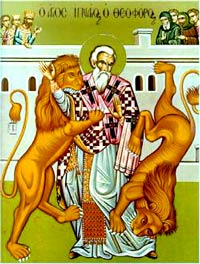
We are told that the martyrs went rejoicing to their deaths as if they were going to a marriage feast. They bathed their hands in the blaze kindled for them and shouted with gladness. They marched into the arena as if marching into heaven. When Ignatius (Ig-nay-shush), an elderly martyr, was about to die for his faith in A.D. 110, he cried out, "Nearer the sword, then nearer to God. In company with God." Now we are not trying to be macabre, nor are we saying anyone should seek an adventurous death. Rather, we are saying that the Christian life often involves suffering.[1]

This scenario is a far cry from us today. In fact in the church today we suffer the burden of sitting for one hour just to hear God's word. The testing we face by cutting our time short for leisure activities to receive from God the essential things of salvation seem almost unbearable. Church almost seems like a life sentence, we fidget and squirm or fall asleep, waiting for the inevitable "amen", so that we might go off and attend to what we like.

Perhaps your mindset is this: My expectations are just not being met in church these days! God is not serving me the way "I" feel "I" should be served. Perhaps to avoid such perilous persecution we should go hunting for a better church product; one that fulfils all our desires and criteria. In my heart "I" just feel that my needs are not being met. God is a God of love; he wants to bless me. So "I" have to find a church where "I" get inspiration and encouragement; a place where "I" get knowledge and instruction; a place where "I" might get a pep-up to boost me through the week; a place where "I" get new friends; and a place where "I" feel "I" get loved.

27 Jesus and his disciples went on to the villages around Caesarea Philippi. On the way he asked them, "Who do people say I am?" 28 They replied, "Some say John the Baptist; others say Elijah; and still others, one of the prophets." 29 "But what about you?" he asked. "Who do you say I am?" Peter answered, "You are the Christ." 30 Jesus warned them not to tell anyone about him.

31 He then began to teach them that the Son of Man must suffer many things and be rejected by the elders, chief priests and teachers of the law, and that he must be killed and after three days rise again. 32 He spoke plainly about this, and Peter took him aside and began to rebuke him.

33 But when Jesus turned and looked at his disciples, he rebuked Peter. "Get behind me, Satan!" he said. "You do not have in mind the things of God, but the things of men."

34 Then he called the crowd to him along with his disciples and said: "If anyone would come after me, he must deny himself and take up his cross and follow me. 35 For whoever wants to save his life will lose it, but whoever loses his life for me and for the gospel will save it. 36 What good is it for a man to gain the whole world, yet forfeit his soul? 37 Or what can a man give in exchange for his soul? 38 If anyone is ashamed of me and my words in this adulterous and sinful generation, the Son of Man will be ashamed of him when he comes in his Father's glory with the holy angels." (Mark 8:27-38 NIV)

Peter's expectations are much like many of our expectations today. On hearing that Jesus was going to die the alarm bells went off for Peter and he acted in a way he believed to be right. That is until Jesus tells Satan to get behind. We too need to realise that error comes in many forms, and it often looks good at first glance and we think we are doing the right thing—but that's why it's called deception. I'm sure the apple looked good in the Garden of Eden too; the one who ate it lacked wisdom and discernment.

All of us have asked the question, "Are my expectations being met?" For Peter hearing that Jesus must suffer definitely didn't fulfil his desires and expectations of Jesus. If Jesus the messiah must suffer, then surely Peter's life would be far from rosy. So he sought to correct Jesus, so he might hear a happier message. But perhaps his question, like ours should be, "Are God's expectations being met?" Or to use Jesus' words to test and ask ourselves, "do I have in mind the things of God, or the things of men?"

Are God's expectations being met in us today? Are God's expectations being met in me? Is the service I'm seeking in worship one that brings glory to God, calling me to put off the old self and carry my cross? Is church more about covering up my true reality? Or is it about exposing it, though painful, and having it nailed to the cross, so we might live in peace with God, even if the world might want to martyr us for doing so.

Many today think that Jesus words "Get behind me, Satan" are for someone else. But these words are for you and for me. We are called to ask ourselves, "Do I have in mind the things of God, or the things of men? We find the essential expectations of God only in God's word, and in hearing his word we receive wisdom to study his word in order that we might discern right from wrong!

In these days of materialism where life is all about personal experience, feelings, and satisfactions, God puts all of his word in front of us and we do well to hear his word of correction, and return to Jesus' way, the only way! So that the Father, the Son, and the Holy Spirit, might rightly take the throne of our hearts over and over again.

God is worthy of honour and respect, he is God, and he deserves it. We need God's true service in his Son Jesus Christ through his word, so the Holy Spirit can bring us holiness and peace right now, even in the midst of great trials and suffering. Jesus is worthy of honour, glory, and respect; and he deserves it too.

God makes demands on your life and my life; to stop, repent, and return to his word! He knows the gravity of my situation and your situation; the life and death struggle that we Christians so quickly turn into a whim about what might please us. Honour and glory awaits all who trust only in Jesus, humility and holiness call us to put our selves, our time, and our possessions a distant second to the narrow road of the cross and the true glory it will bring us in eternity. Amen.


[1] #20 from Encyclopaedia of Sermon Illustrations, Concordia, St Louis, 1988, page 16